

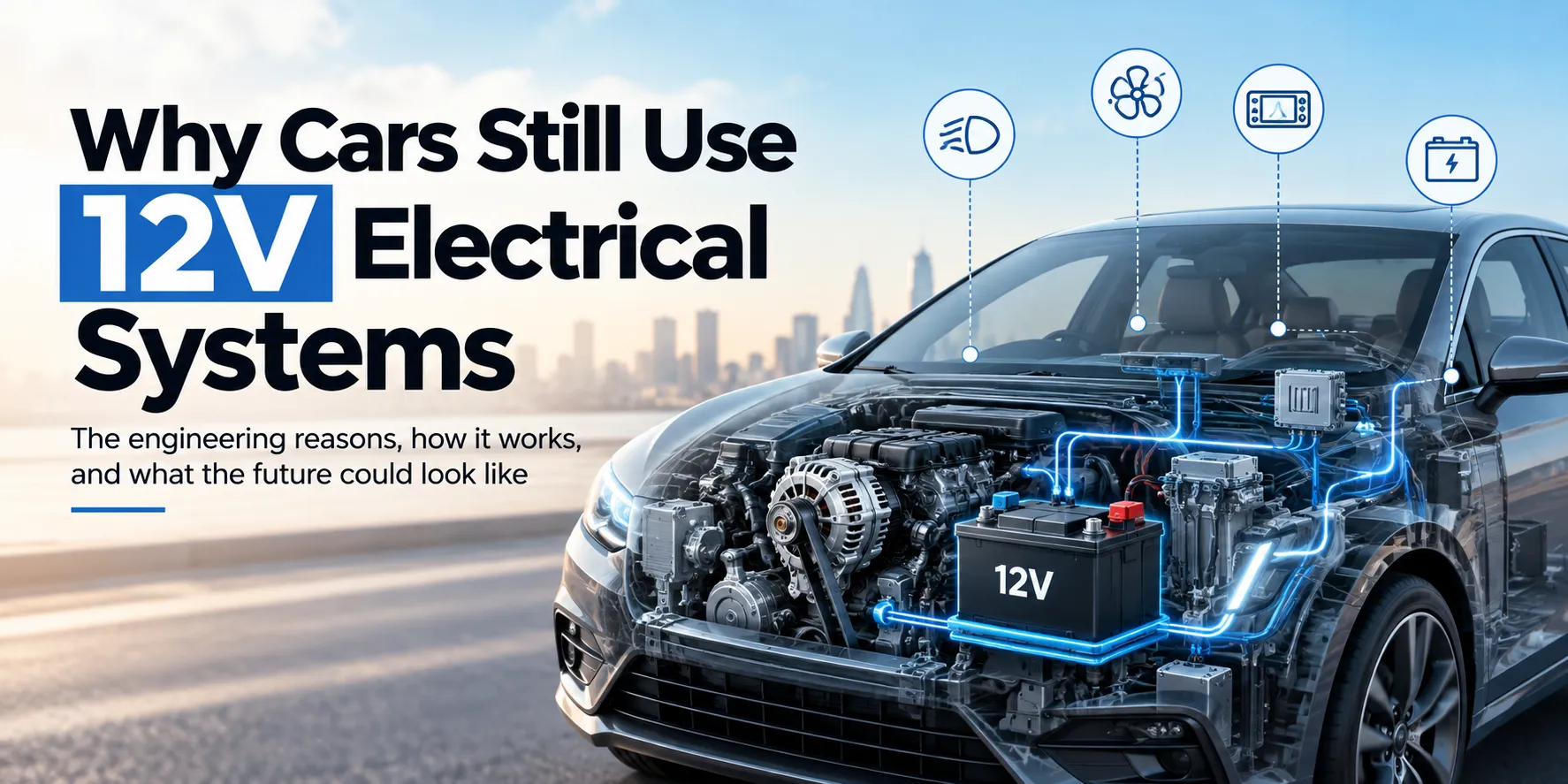
Why do modern petrol and diesel cars still rely on a 12V electrical system when vehicles now contain sophisticated computers, sensors, infotainment systems, safety equipment, and electrically powered accessories? The answer is largely rooted in engineering practicality, compatibility, cost, safety, and decades of automotive development.
A conventional vehicle uses its 12V network to power a wide range of functions, from lighting and engine control electronics to locks, instruments, sensors, entertainment systems, and standby electrical loads. The alternator normally supplies electrical power while the engine is running and also maintains the starter battery.
Understanding how this architecture works helps explain why the 12V electrical systems used in conventional vehicles remain important—and why engineers continue to explore different ways of managing their electrical loads.
What Is a 12V Electrical System?
A 12V electrical system is the low-voltage electrical network used in most conventional petrol and diesel passenger vehicles and many commercial vehicles.
Its main components typically include the starter battery, alternator, wiring, fuses, control modules, lighting, motors, sensors, and other electrical loads. Although commonly called a “12V” system, the actual voltage varies depending on operating conditions. A fully charged lead-acid starter battery can measure above 12V when at rest, while the alternator normally operates at a higher voltage to recharge the battery.
The basic principle is straightforward: the battery stores electrical energy, while the alternator converts mechanical energy from the running engine into electrical energy for the vehicle.
This architecture has remained practical because most vehicle accessories and electronic systems can operate effectively within this voltage range.
Why Do Cars Use 12V?
There is no single reason why cars use 12V. The architecture is the result of several engineering considerations.
A Practical Balance Between Voltage and Current
For a given electrical power demand, increasing voltage reduces the current required. However, raising system voltage also introduces different requirements for insulation, components, protection, and system design.
The 12V range provides a practical compromise for conventional automotive applications. Components can be designed around relatively low electrical voltage while still supplying the power needed by many vehicle systems.
For example, a small motor, control module, lamp, sensor, or electronic accessory can be powered from the vehicle’s low-voltage network without requiring the electrical architecture used for high-voltage propulsion systems.
A Long-Established Component Ecosystem
Another reason is compatibility. Automotive electrical systems have developed around the 12V architecture for decades.
Manufacturers, suppliers, repair specialists, and engineers have extensive experience designing components for this voltage range. Starter batteries, alternators, relays, fuses, wiring, connectors, and electronic control units are all integrated into established vehicle architectures.
Changing the fundamental electrical architecture of a conventional vehicle would therefore involve more than replacing a battery. It could affect numerous components and interfaces throughout the vehicle.
How Does a 12V Automotive System Work?
In a conventional petrol or diesel vehicle, the starter battery provides electrical energy when the engine is not running. It supplies the high current required by the starter motor during engine cranking and also powers electrical equipment when the engine is switched off.
Once the engine starts, the alternator becomes an important source of electrical power.
The alternator is mechanically driven by the engine, usually through a belt. As it rotates, it generates electricity that can supply vehicle loads and recharge the starter battery.
This creates an important relationship between electrical demand and engine operation.
When the vehicle has substantial electrical loads, the alternator has to generate more electrical power. Because the alternator is mechanically connected to the engine, generating that power requires mechanical energy from the engine.
This is why alternator load is an important consideration in vehicle energy management.
What Happens When Electrical Loads Increase?
Modern vehicles can have many simultaneous electrical loads.
Headlights, climate-control blowers, heated systems, infotainment equipment, electric pumps, fans, control modules, communication systems, and other accessories can all contribute to the vehicle’s electrical demand.
The alternator must respond to this demand while maintaining appropriate system voltage and keeping the starter battery charged.
The result is an interconnected energy system: the engine provides mechanical power to the alternator, the alternator produces electrical power, and the electrical system distributes that power to the vehicle’s loads.
For engineers and fleet operators, understanding this relationship is particularly relevant when vehicles accumulate additional electrical equipment. Accessories added during vehicle electrical system retrofits can increase the continuous electrical demand placed on the vehicle.
Why Not Simply Replace the 12V System?
For conventional petrol and diesel vehicles, changing the entire electrical architecture can be complex because so many systems depend on the existing design.
A vehicle’s electrical architecture is not an isolated component. It is integrated with engine management, starting, charging, body electronics, safety systems, communications, diagnostics, and accessory equipment.
This is also why auxiliary electrical systems can be an interesting area of automotive engineering. Instead of redesigning the complete vehicle, an auxiliary power approach can examine how particular electrical loads are supplied and when energy is available.
The proposed Nulldraw concept takes this approach as a design in development. It is intended to use a grid-charged auxiliary battery to supply a conventional vehicle’s 12V electrical loads so that the alternator can idle under appropriate operating conditions. The engine, alternator, and starter battery remain part of the vehicle.
This concept should be understood as an engineering design under development, rather than as a commercially available product.
Where Could Auxiliary Power Architecture Matter?
Electrical demand is not identical across every vehicle or operating pattern.
A passenger car used primarily for short urban journeys may experience different electrical operating conditions from a commercial vehicle equipped with additional equipment and spending long periods in traffic or at low engine speeds.
Fleet vehicles can also accumulate electrical accessories over time. This makes vehicle energy architecture relevant when considering auxiliary equipment, retrofit requirements, and electrical load management.
The broader subject of auxiliary power systems is therefore connected to a simple engineering question: does every electrical load need to be supplied in exactly the same way and at exactly the same time?
That question does not eliminate the need for the conventional 12V architecture. Instead, it opens up possibilities for examining how electrical energy can be generated, stored, and distributed within existing vehicle designs.
The Future of Conventional Vehicle Electrical Systems
The 12V electrical system remains deeply integrated into conventional vehicles because it provides a practical foundation for starting, control electronics, lighting, accessories, and other electrical functions.
At the same time, increasing electrical loads make energy management an important engineering consideration. The challenge is not simply producing more electricity; it is understanding when electrical energy is required, where it comes from, and how that demand interacts with the engine and alternator.
For conventional petrol and diesel vehicles, future developments may therefore involve improvements in energy architecture and load management rather than abandoning the established 12V network altogether.
Conclusion
Cars still use 12V electrical systems because the architecture offers a practical combination of compatibility, established components, manageable electrical requirements, and integration with conventional engine and charging systems.
The starter battery provides stored electrical energy, while the alternator converts mechanical energy from the running engine into electrical power for vehicle loads and battery charging. As electrical demands increase, the relationship between those loads and alternator operation becomes increasingly relevant.
Understanding this architecture also provides context for emerging auxiliary power concepts. Designs such as Nulldraw’s proposed system explore whether selected 12V electrical loads could be supplied through an additional grid-charged energy source while retaining the vehicle’s existing engine, alternator, and starter battery. The key point is that the 12V network remains a fundamental part of conventional vehicle energy architecture—and understanding how it works is essential to evaluating any proposed change around it.