


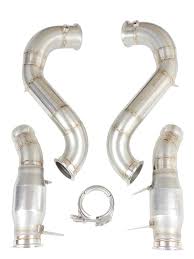
There’s something quietly addictive about performance upgrades. Not the flashy kind that screams for attention, but the ones you feel—in the throttle response, in the way the engine breathes, in that deep, refined growl that makes every drive just a bit more personal. If you’ve ever spent time around AMG enthusiasts, you’ll know… they chase that feeling more than anything else.
And somewhere in that journey, downpipes tend to enter the conversation.
Why Downpipes Matter More Than You Think
At first glance, downpipes sound like just another piece of exhaust hardware. But in reality, they play a pretty critical role in how your car performs. Positioned right after the turbochargers, they help manage how exhaust gases exit the engine. And if you’ve ever driven a turbocharged AMG, you already know—efficiency here changes everything.
Stock downpipes are designed with restrictions. That’s not necessarily a bad thing—they’re built to meet emissions standards, noise regulations, and long-term reliability expectations. But for enthusiasts? They can feel… limiting.
Upgrading your downpipes reduces backpressure, allowing the turbo to spool faster. The result? Sharper acceleration, smoother power delivery, and, yeah, a more aggressive sound that feels just right without being over the top.
The AMG Personality: E53 vs E63
Now, let’s talk specifics for a second.
The E53 AMG is a bit of a hybrid personality. It’s refined, intelligent, but still has that sporty edge. It doesn’t shout, it suggests. On the other hand, the E63 AMG? That’s a completely different beast. It’s loud, unapologetic, and built for drivers who don’t mind turning heads at every red light.
Because of these differences, the kind of downpipe upgrade you choose can vary quite a bit.
For example, upgrading a downpipe mercedes e53 amg setup is often about balance. You’re not necessarily trying to transform the car into something wild—you just want to unlock a bit more responsiveness and give the engine room to breathe. The goal is refinement, not chaos.
With the E63, things get… a little more intense.
Catted vs Catless: The Debate That Never Ends
If you’ve spent even a few minutes researching exhaust upgrades, you’ve probably come across the “catted vs catless” debate. And honestly, it’s one of those topics where there’s no universal answer—just preferences.
Catted downpipes include high-flow catalytic converters. They reduce emissions while still improving performance compared to stock components. They’re quieter, cleaner, and generally more street-friendly. For many drivers, that’s the sweet spot.
Catless downpipes, though? They remove the catalytic converter entirely. This leads to maximum airflow and, in turn, maximum performance gains. The sound is noticeably louder, deeper, and a bit raw. It’s the kind of upgrade that makes you grin on every acceleration… but it also comes with trade-offs like increased emissions and, in some places, legal concerns.
When it comes to mercedes e63 w213 catted and catless downpipes, the choice often comes down to how you use your car. Daily driver? Catted might make more sense. Weekend machine or track-focused build? Catless starts to look very appealing.
What It Feels Like Behind the Wheel
Specs and numbers are great, but they don’t tell the whole story.
The real magic happens when you’re driving. You press the accelerator, and there’s this immediate sense of urgency—like the car is more awake, more responsive. Turbo lag feels reduced. Gear shifts feel tighter, more purposeful. And then there’s the sound…
It’s not just louder—it’s richer. More layered. You start noticing tones you didn’t before, subtle crackles on downshifts, a deeper resonance under load. It’s the kind of change that doesn’t just affect performance—it changes how you connect with the car.
And that’s really what most enthusiasts are after.
Things People Don’t Always Talk About
Upgrading downpipes isn’t just about bolting on a part and calling it a day. There are a few things worth keeping in mind—stuff that doesn’t always make it into flashy YouTube videos.
First, tuning. Many downpipe upgrades work best (or require) an ECU tune to fully optimize performance and avoid issues like check engine lights. It’s not complicated, but it’s something to plan for.
Second, heat management. Better airflow often means higher temperatures in certain areas. Quality components usually address this, but it’s still worth considering.
And lastly, expectations. Not every upgrade transforms your car overnight. Sometimes, the improvements are subtle—but over time, they add up to something that feels genuinely better.
Is It Worth It?
That’s the big question, right?
If you’re someone who enjoys the driving experience—not just getting from point A to B, but actually feeling the car—then yes, downpipes can absolutely be worth it. They’re one of those upgrades that sit at the intersection of performance, sound, and driver engagement.
But if you’re perfectly happy with how your AMG drives right now, there’s no rush. Cars like the E53 and E63 are already incredibly capable machines. Upgrades should enhance your experience, not feel like a requirement.
Final Thoughts
There’s no single “right” way to build or modify a car. Some people chase horsepower numbers, others care about sound, and some just want a more connected driving experience. Downpipes, in many ways, sit right in the middle of all that.
They’re not the flashiest upgrade. They won’t always get attention at a glance. But once you’ve experienced what they do—how they subtly reshape the character of your car—it’s hard to ignore their value.
And maybe that’s the best kind of upgrade. The kind you don’t just see… but feel, every time you drive.